
Fire Drill Readiness for Nursing Care Centers: Meeting Joint Commission Standards
To support both safety and regulatory readiness, this blog will explore key Joint Commission standards for Nursing Care Centers. This blog will discuss the details of the standards to ensure compliance, avoid common pitfalls and provide guidance for emergency operation plans.
Drill Frequency
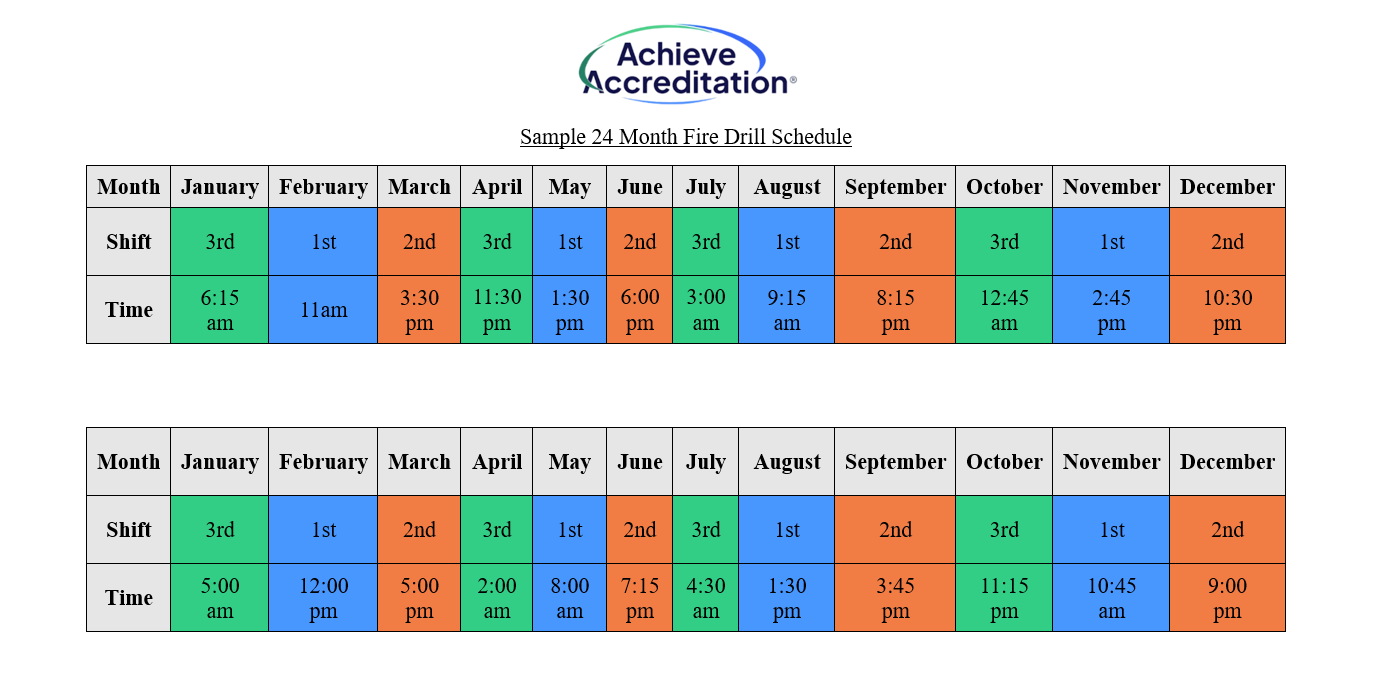
It is required that each of the organization’s shifts practice the fire drill quarterly. Draft a one to two year-long drill schedule that outlines quarterly drills per shift, with varied times, rotating locations and scenarios (e.g., kitchen fire, laundry room smoke, resident room fire). This discourages predictability and exercises different teams and compartments. Fire drills must be unannounced and at unexpected times. Specifically, the time of the drill must vary by at least one hour for drills on the same shift from quarter to quarter for 4 consecutive quarters. This can be tricky when state regulations may require you to vary the drills by 2 hours from quarter to quarter. But, with advance planning, the Joint Commission standards and regulations are attainable!
Additionally, nursing care centers must ensure they are avoiding other patterns such as drills scheduled on the same day of the week or on the same day of the month (e.g. the 4th Wednesday of every month).
Take a look at Achieve’s 24-month cycle sample drill schedule.
Alarm & System Activation
Drills should simulate realistic conditions and include transmission of alarm signals and system activations. Daytime drills should include audible and visual alarm activation.
Ensure the organization’s policies and procedures address night shift fire drills that meet Joint Commission standards, as well as, state and federal regulations. Joint Commission standards indicate that an announcement or direct staff notification may be used in lieu of an audible alarm when drills are conducted between 9:00 p.m. and 6:00 a.m. Staff must fully enact the steps outlined in the organization fire plan. The audible alarm must be tested at another time to fulfill the monthly testing requirements.
Drill Scenarios
Once staff have a strong understanding of the basics of the fire plan, add contingencies to the drills, such as blocked corridors, or another type of simultaneous emergency (e.g. flooding, elopement, Code Blue, etc.) to further test staff knowledge and response.
Drill Evaluation
Station observers above, below, and adjacent to the drill area to assess alarm audibility/visibility, functioning of fire and smoke doors, smoke/compartmentation practices, and staff execution of protocols. Drills should evaluate both staff actions and building features (doors, dampers, hold-opens, alarms, sprinklers).
Ensure follow-up education is provided to address identified areas for improvement noted during the drill. Perform a focused follow-up drill if needed to ensure staff understanding.
The scored evaluation should include, but may not be limited to, the following:
Alarm performance: Did signals transmit to the panel and off-site responders (if applicable)? Were strobes visible everywhere they should be?
Door/compartmentation: Did fire/smoke doors release and close? Were doors kept closed to contain smoke?
Staff response: Evaluate staff’s response time- Were protocols followed including calling the alarm/code, bringing an extinguisher, closing doors, horizontal relocation procedures initiated (as applicable)?
Additional Resident safety actions: Consideration of residents with dementia or other needs requiring additional support.
Communication: Clear announcements per policy (i.e. overhead, radio/phone) and notification of required individuals/organizations
Analyzing the results of the drills will allow organization leaders to identify areas of the fire plan that may need updating, targeted education, and/or building features that require adjustments or upgrades. Documenting these identified areas for improvement is a critical step and serves as the road map for your follow-up actions. Gathering information but not analyzing and using the information to make improvements is one of the most common pitfalls.
In summary, drills should be used as an opportunity to proactively identify areas that need tweaking. By varying the day of the week, time of day, and locations in the building, organization leaders will obtain data that is representative of the facility’s 24/7 operations. Conducting a drill just to satisfy a requirement and filing it away without carefully evaluating the performance is a missed opportunity for ensuring organization preparedness and safety.
